Monday, February 17, 2014

Creativity + Diverse Perspectives = Deeper Education

When one considers the word creative, it’s easy to think of the arts. After all, what is more creative than the expression one gives to her work with a musical instrument, including her voice, a photograph, sculpture, or painting, or the way an actress embodies on stage? In English, one can be creative through a work of prose or poetry.  Creativity can be found in every subject area. Thinking outside-of-the-box involves a creative approach to problem-solving. 


As teachers, creativity is found in the way we plan and execute our lessons. It is also found in the way we collaborate as faculty. One of the most enriching and creative means of professional development I have been engaged with occurred over the last two years. Through the facilitation of Renee Hawkins, Director of Instructional Technology at Garrison Forest School, we had three teams of faculty working with the organization Powerful Learning Practice. These teams were not organized around a single discipline or division but rather across them. By spending time together working on similar goals, we learned a great deal about each other, about the students we teach at each level, about our subject areas, and about our approaches. We pushed ourselves out of the “silos” of our teaching areas and united our collective energy, enthusiasm, intellect, and curiosity together toward learning that enriched all of us.
Then, we shared what we learned with our colleagues both formally in professional development days and informally through conversations and meetings times that we created to discuss new ideas.

We have embraced the kind of sharing that not only helps education grow deeper and broader, it helps create new products. In a story aired on National Public Radio in January celebrating the 30th anniversary of the first Apple Mac products, the story described a design team which included a medical doctor, musician, “self-educated drop-out”, artist, archaeologist, as well as computer experts. As the current Apple CEO, Tim Cook noted, “We define diversity with a big D…. It's not just the traditional measures of diversity, which are incredibly important, but also diversity of thought.” (Morning Edition)

At Garrison Forest School, we embrace diversity in all respects, including a diversity of thought and experience. Each person’s experience, expertise, and perspective adds to our learning and growth. Opening ourselves to each other’s creative approaches and views enriches us.


Sunday, September 29, 2013


Traveling with a child: Good medicine for the soul  
As a result of a school grant , I was able to travel with my partner and our four year old daughter, Bella, to the Pacific Northwest for three weeks, combining camping and Bed & Breakfast stays. The adventure began when we flew into Portland, Oregon and rented a mini-van. Our journey took us through five states, five National Parks, and 3306 miles in three weeks.

As a U.S. history teacher, it was quite powerful to see the majesty and varied terrain of the five states we visited. Simply put, we were in awe. We were also reminded of the simplicity of seeing the world through a child’s eyes. In our post 9/11 world, we, adults, are so cautious and sometimes distrustful. When I was a child, it was absolutely normal to run outside after returning home from school and playing with neighborhood children. Yes, there was “stranger danger” but not like today. There was something about camping in National Parks that allowed us to go back to that era.  Each time we set up a new camp Bella asked us to help her find a new friend. Believe me, she did not need help. She broke down walls of unfamiliarity with ease. Yes, we were with her to be sure she was safe yet, her ready smile and genuine desire to meet new people collapsed any barrier that we adults put up when meeting people outside of what is familiar to us.

Beyond finding new friends, Bella reminded us that we can create new adventures with anything that surrounds us. In Olympic National Park we walked to the beach and immediately, she began racing the waves. As the tide went out, baby dungeness crabs littered the beach. She said she wanted to save the “taxicrabs” and send them back to the ocean. She did not need a pre-determined set of rules or planned activity. Yes, again, we were there to keep her safe but she explored, created, and learned. Our little adventurer helped us have a truly grand journey on land and in our hearts. Perhaps we all need to let our guard down a bit more in order to meet new friends and create new adventures of our own.

Wednesday, April 10, 2013

Building financial literacy and nurturing confidence in children


Children need to learn basic economic concepts early. One might think this is only to help them keep track of their finances. However, it is a much bigger issue than that. Girls, in particular, need to learn to negotiate and value their own worth. Dr. Linda Babcock, an economist at Carnegie-Mellon University notes, “I tell my graduate students that by not negotiating their job at the beginning of their career, they're leaving anywhere between $1 million and $1.5 million on the table in lost earnings over their lifetime.”[1] In fact, that loss is in the salary alone. Factor in what is lost in benefits which are based on salary, quite often, one loses even more.

The more we integrate vocabulary related to financial literacy into our everyday conversations, the more comfortable our children will feel with the concepts.  The more we discuss everyday financial experiences, the more successful they will be with handling their own finances.

Don’t wait until your children are older to begin to help them develop the language and skills that will make them competent, confident, and effective managers of their financial lives. 


Look for opportunities to use the word trade-off. When we make choices, we are accepting a trade-off.
·        Choose to go to the park instead of a movie
·        Choose one item at the store instead of another
·        Choose to read a book rather than watch television
·        Choose peas over carrots

Another way to look at trade-offs is to consider equivalents.
What is the equivalent value of:
·        A year of tuition?
·        Riding lessons?
·        Money spent at Target in a week or month?
·        Money for a week-end of "fun"- itemize what was spent.

Sit down with your children and go over the grocery receipts.  Which items are wants? Needs?  If your children are older, let them see the utility bills. Talk about what happens when the lights are left on and water is left running. All of these affect the bills. When money is spent on bills, the trade-off is less money for wants.

Look at the collection of Halloween candy amassed by trick-or-treaters. Talk about setting a limit on the number of pieces to be eaten in a day.  This is a budgeting basic.  If one does not consume all at the moment but saves some for later, what one has saved will last over a longer period of time.
ACTIVITY: Decorate four jars of equal size. Make a coin size hole in the top of each. Then put four different labels on the jars: spend, save, donate, and invest. This will help your child see different ways to budget money. You can talk about your family values with relation to these categories, too.


Talk about chores. Do you expect chores to be done? How does this contribute to the household? How does this put a value on how one uses time?  How does this tie in with trade-offs and decision-making?

If your child wants money to donate to a charity, consider having her earn it by performing chores for a neighbor or relative.  Discuss the value of earning money instead of simply handing it over.  This might be a good opportunity to talk about groups who stand on street corners in "bucket brigades" to collect for a group.  Could your child find a way to raise money that puts value back into the community- a car wash, raking leaves, babysitting and giving that money to the desired group as opposed to keeping it? Talk about the value of one's time when babysitting or raking leaves in the neighborhood.  What are your skills and time worth?  If your child simply says, I'll take whatever they give me, how might this translate into a willingness to ask for a fair salary later in life?  This might be a great time to talk about negotiation, a life skill.

The bottom line is that financial literacy opportunities are all around us. With a bit of time and thought, we can help our children build skills and confidence that will last a lifetime.

Some helpful links:
PROGRESS- Program for Research and Outreach on Gender Equity in Society – offers some great, simple tips for teaching negotiating skills to girls and women 


[1] Ludden, Jennifer. National Public Radio, "Ask For a Raise, Most Women Hesitate." Last modified 2011. Accessed April 9, 2013. http://www.npr.org/2011/02/14/133599768/ask-for-a-raise-most-women-hesitate.

Image links: http://www.universitybusiness.com/sites/default/files/styles/crop-tool-350x250/public/field/image/dollars%20and%20sense.JPG?itok=g5fs-9jQ 

https://images-onepick-opensocial.googleusercontent.com/gadgets/proxy?container=onepick&gadget=a&rewriteMime=image/*&url=http:/

%2Fmarkwilliamsinternationaldotcom.files.wordpress.com%2F2011%2F10%2Ffc00.gif%3Fw%3D150%26h%3D146
https://blogger.googleusercontent.com/img/proxy/AVvXsEgM1xxdSxNVEQJhwscKNdoMXwaaxLbbNXCedeEcZw56olTa4r8EfI-kkR26OGXt5glwuldGK8aqRrspzF-0LXe_fa5mQdl3ayO7r4ajXLHbTiuNJDCXpBT_Kmq0GwVpFst2hp-Rn_FEgwpQ050T-dF3DYF6eoATkIpfvIA00YnyQZ9sPMU8eRcrM_CphdFirjJFjqQ1fxYb=

Tuesday, March 5, 2013

Paying it forward through literacy

“The loss of a tongue is a social, cultural, and even spiritual problem”

- María Virginia Haoa is one of the founders of the Rapa Nui Language Academy, Chile


Teaching is so very far from being a one-way street. I am constantly inspired by my former students. I have had some alumnae come back to school - live and through Skype- and speak to my Economics class as mentors in the business world. Some have come back to speak about their work as lawyers helping to sort out the chaos of the legal system in New Orleans after Hurricane Katrina. Another former student shared her work in helping to eliminate "Food Deserts" in Baltimore City.  All of these women (I work in a girls' school Garrison Forest School) are leaders in title and/or example. They create, innovate, and give back to the community.

Ah, giving back. That is where my heart lies.  If my students learn nothing else, I hope they learn about the value of using their gifts and opportunities not only to make themselves happy but, to help others. I adored the concept of "paying it forward" long before it was a movie or catch-phrase. I see my role as a teacher as paying it forward by educating students not only about content but about their responsibility for doing positive work in the world, whether through vocation or avocation.


And what of alumnae, paying it forward, and literacy? Another of my former students, Kate Joyce, joined the Peace Corps after college (actually, a number of my former students have joined the Peace Corps). Among her other jobs have been guiding a girls' magazine and serving as director of a book bank that provided books to massively under-served areas of the world. Her latest venture is the creation and directorship of Mother Tongue Books, a non-profit whose mission is to provide books in the original language of people in areas of the world that have limited resources, particularly books. As they note on their webpage,

"The lowest literacy rates in the world are in countries where affordable good books are not available in the languages people speak, so Mother Tongue Books translates good children's books into mother tongue languages and distributes them through organizations already doing development and education work in low-literacy countries."

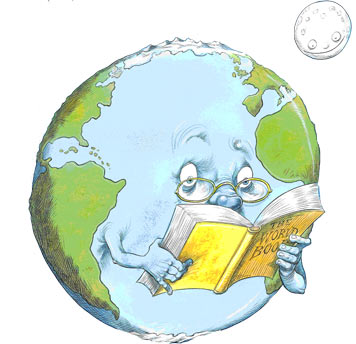
Image from : http://customtripplanning.files.wordpress.com/2012/05/the-world-book-globe.jpg

What could be a greater way to pay forward her education and opportunities than to bring literacy to others, in their language? It is not as simple as taking American children's stories and translating them. American stories are filled with cuddly bears and pigs. Imagine these books in the hands of children for whom pork is sinful or bears are frightening. Producing these books involves tremendous cultural literacy.  They also pose a great opportunity for students. Some of our students taking advanced levels of French are working on the translation of culturally appropriate books into French. Not only are they performing a service, they are applying their language skills and they are engaging in meaningful cross-cultural education.

Mother Tongue books is a young venture with a bright future and ample opportunities for student engagement. Travelers, too, can be part of enriching literacy across the globe. Stop in a local bookstore and find a book that is culturally relevant. Send it along to Mother Tongue for translation. They will get it into the hands of children who will benefit so very much from the opportunity to develop their literacy.

Let us all help "pay it forward" by encouraging young leaders and visionaries by supporting their good works. Simple steps can make a world of difference.

For more information about Mother Tongue Books, check out their website or contact:
Kate Joyce, Executive Director
kate@mothertonguebooks.org

While we're at it, let's celebrate World Read Aloud Day


Sunday, March 11, 2012

The Process of Making a Difference

Over the last few weeks the students in my Peace Studies class have been identifying issues which interest them so that they can develop a plan of action to try to address the issue. They have now created their action plans and are attempting to raise awareness and to make a difference, if only a small one. The sheer fact that they are trying to make a difference is a step forward. It has been exciting to see the range of topics being explored- from packaging food that was made but never served in our dining hall and sending it to local food kitchens to addressing adult illiteracy to protesting against puppy mills.  

 From: peaceactionphiladelphia.org

Each student is expected to identify and analyze:
* the causes of the issue and its history
*  the organizations (Governmental and/or Non-Governmental (NGOs) working in the area of their issue. They must identify and discuss:
§  who they are;
§  what they are doing;
§  what their successes are;
§  what obstacles they face;
§  and whether or not they making progress and how one  can tell.
·        They must describe the criteria they are using to gauge success- use of philanthropic dollars, impact on the problem, education, rehabilitation, placement of those who are oppressed (ex. places to live for those who are homeless), other?
·      
* any other people who are involved with the issue and what they are doing. What is working? What isn’t? Why?
*how the issue relates to peace, social justice, and non-violence, as well as why the issue is important. Why should we care about it?

The culmination of this project is a multimedia presentation of their analysis of the items above as well as their analysis of the action plans and their effectiveness. 

These students would benefit from feedback. Those who have social media sites so far can be reached at: 
AIDS in South Africa 

Please encourage these students with your questions and reactions.

Monday, February 20, 2012

True learning involves direct action

I am one of the members of my school's cohort through Powerful Learning Practice as we explore how to implement 21st century learning skills effectively. This year we have joined several teachers from Pennsylvania schools. Our focus is on Inquiry-Driven Instruction. As a group, we decided to target our explorations on the question of "How can we make a difference?" Each of us is working with a group of students to have them try to find ways to answer that question and, in fact, make a difference. We are sharing our processes, obstacles, and successes through our blog.

I have to admit that I am not starting from scratch with this project. I have been teaching Peace Studies for several years and each year the students have been assigned a Peace Action Project.  However, I have adapted our project to include even more 21st century skills, especially including more feedback and insight from outside of our community.

Students in the class range from grades 10-12 and students in the school come from all over the world. Their major project is to identify a problem, research it, develop and implement an action plan (to make a difference), and to create a multi-media presentation of all of their work and their evaluation of it. Last year was the first year I required the multi-media presentation. In the past, students turned in term papers. I was blown away by their presentations. Not only were they exceptionally well-done, but I realized that a term paper is between the student and me. The presentations led to much greater learning.  I was sold.
From: http://www.fiveaoks.on.ca/


This year my students have projects including a comparison of homophobia in China and the U.S. (a Chinese student is doing this one), puppy mills, food waste in local restaurants, human trafficking, teen dating abuse, and much more. Each student must create and enact an action plan to try to make a difference. These plans will be in effect for a minimum of six weeks. Part of their work will involve communicating with someone in the field who is already trying to make a difference. They must communicate via email, twitter, facebook, or some other social media, or skype. Note: We have discussed how to find people through these media and then how to communicate with them. In addition, we have discussed what type of information they should not be giving out.

For their plans they are required to identify what they will do, when, and what resources they need to accomplish their goals. It is through direct action that they will become even more involved in the process of being change-agents. Research is valuable but actually trying to make a difference opens a whole new world. Personally connecting with others, seeing the obstacles, and reviewing what has worked and how to make adjustments gives students skills that go well beyond what they can find in any book.  Let the deep learning begin!

Saturday, October 22, 2011

Un-doing the Expected

Yesterday, one of our students led a lunch-time fast to raise awareness of the famine in Somalia. That, in and of itself, is not something that is so uncommon in an educational setting. Student group after student group endeavors to raise awareness about one cause or issue or another. For over a week, Sara, the student, had been making announcements and she hosted a discussion about the famine. Sara is the student head of Amnesty International. What made the awareness exercise so unusual and so powerful was uncommon fund-raiser that accompanied the fast. In partnership with our school's "Service League", the student-led umbrella organization for all community service activities, a food-less,  or "un", bake sale was held to raise money to donate for Somalian relief. That's right. NO food was sold. Baking dishes and plates were put out and even some crumbs and sprinkles could be found here and there.
Instead of food, students and faculty found signs which indicated what a dollar could purchase in the equivalent of rice or some other food product.  The impact was tremendous. The donation jar quickly filled. I was surprised and pleased to learn later in the day that the donations were far greater than I had ever heard earned at any bake sale in the 25 years that I have been at my school.

Why did this succeed? I believe it was because the students tried something new. They challenged each other to look at information differently. For the rest of the day the halls were buzzing with student and faculty discussions about the impact of the "un"-bake sale.

If students are willing to try new things to teach each other, we should be at least as willing to do so as well.